

The Fear on His Face
Everything Tom Steyer doesn’t want you to connect.

A documented look at the money, the map, the hypocrisy, and why a billionaire who would “still be fine” if he didn’t win, is running like someone who very much would not be.
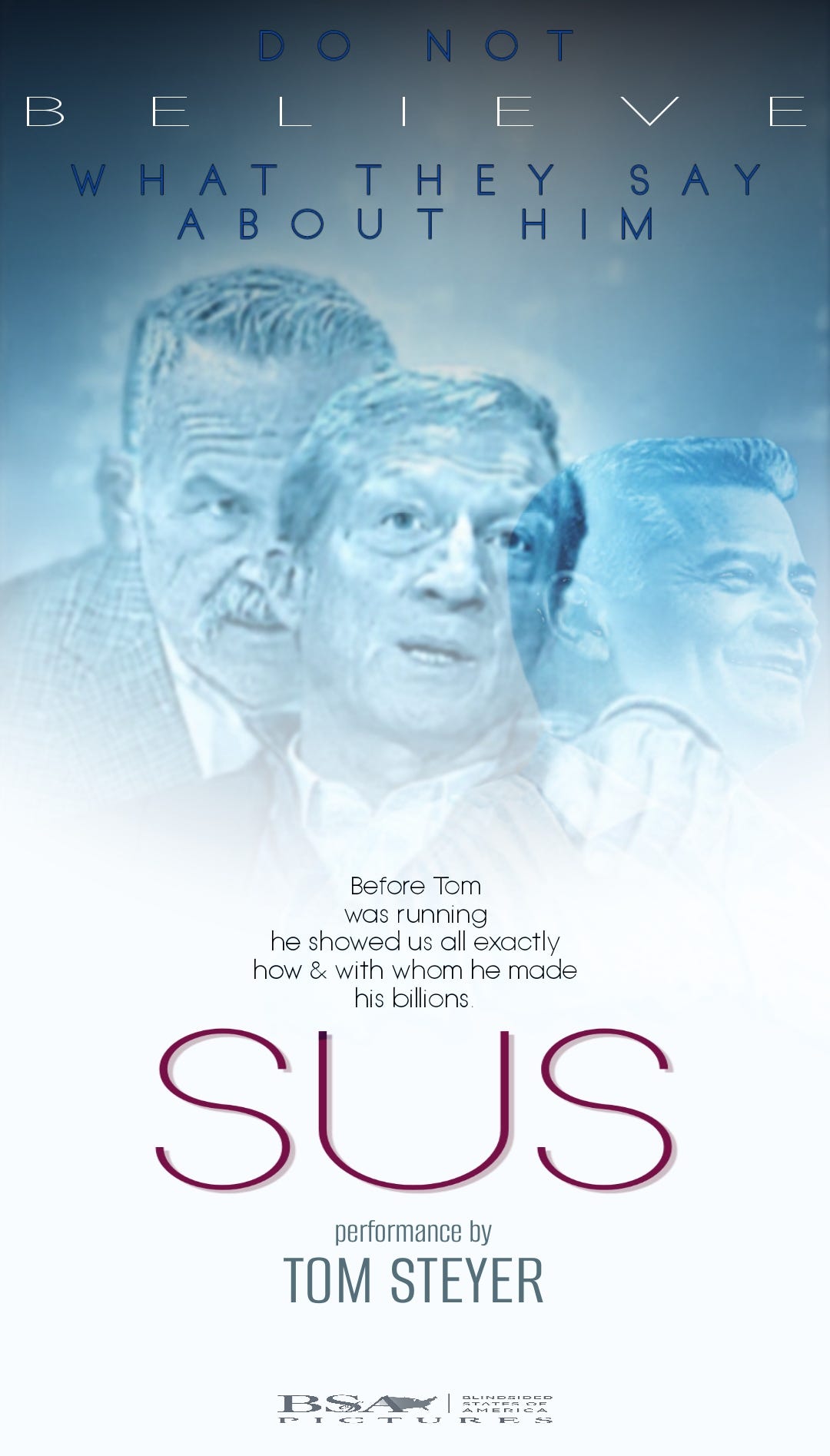
BLINDSIDED STATES OF AMERICA™
We noticed it before we could name it.
Not the money. Not the ads. Not even the scorched-earth attacks on a man whose environmental record Steyer himself spent years praising in public. We noticed the expression. The specific quality of fear visible on Tom Steyer’s face every time the polling narrows, every time a debate goes sideways, every time Xavier Becerra’s name trends.
A billionaire losing a governor’s race should not look like that.
Wounded pride looks like something specific. This looked like something else. It looked like a man who had already made promises he could not keep if he lost.
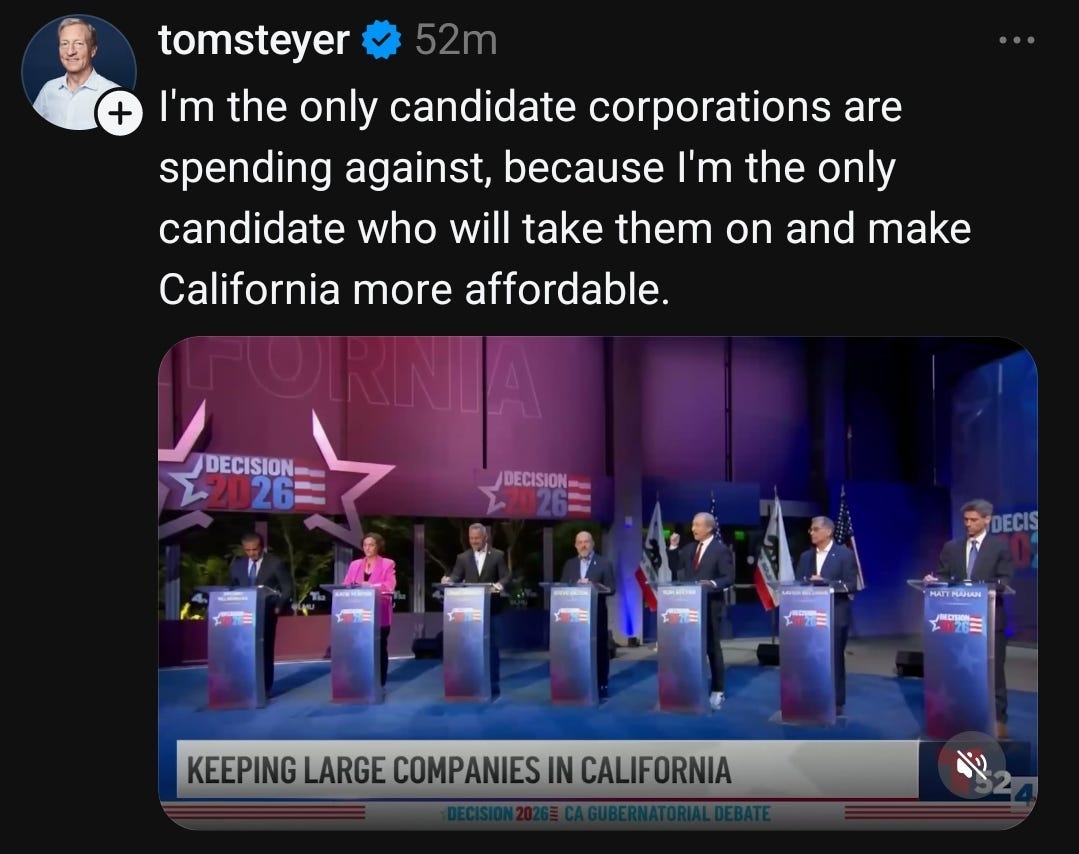
We sat with that observation for a long time without being able to locate the source. Now we can. And once you see the full picture, nothing about this race looks the same.
“Mr. Oil’s” Son and the Hedge Fund Named After Sharks
To understand Tom Steyer’s behavior in 2026, you need to understand who raised him and how he made his money.
His father, Roy Steyer, was a partner at Sullivan & Cromwell, the white-shoe law firm that represented Goldman Sachs for decades. Among colleagues, the elder Steyer was known as “Mr. Oil.” Tom grew up on the Upper East Side of Manhattan, attended the Buckley School and Phillips Exeter Academy, graduated summa cum laude from Yale, earned an MBA from Stanford, and then went to work at Goldman Sachs under Robert Rubin, the future Treasury Secretary who became his lifelong mentor.
What Rubin taught him was not investing, exactly. It was a posture. When corporate mergers created volatility and other investors fled, Steyer learned to embrace it, calculate probabilities, and position accordingly. That lesson governed the next four decades of his life, right up to this campaign.
In 1986, he left Goldman and founded his own hedge fund in San Francisco. He named it Farallon Capital, after a cluster of islands thirty miles west of the Golden Gate Bridge known for their shark-infested waters. That was not an accident. Farallon generated returns of 16.7% annually and became, by 2006, the world’s largest hedge fund. Steyer’s methodology was specific: find distressed or flagging assets, make sophisticated bets on them, and conduct ruthless legal and corporate campaigns to force their value up.
Over 26 years, he turned $8 million into $30 billion.
What he invested in to do that is the part his current campaign would prefer you not examine.
The Fossil Fuel Fortune He Built Before the “Climate Awakening”
SEC filings show that while Steyer was senior managing partner at Farallon, the firm owned stock in ten oil and gas companies totaling roughly $440 million, or about 10% of Farallon’s publicly disclosed equity portfolio. That is the documented baseline.
The specific holdings go further. Farallon held a $220 million stake in Nexen, a Canadian oil sands producer. It held $125 million in Kinder Morgan pipeline securities. It held a substantial position in BP. It financed coal project acquisitions in Indonesia and Australia valued at more than $2 billion. Coal-mining companies that Farallon invested in under Steyer increased their coal production by 70 million tons annually after receiving Farallon’s money. As late as 2014, two years after Steyer announced his retirement from Farallon and his “climate awakening,” he remained invested in the Maules Creek coal mine in Australia.
And then there were the private prisons. Farallon purchased nearly $90 million of Corrections Corporation of America stock under Steyer’s watch, acquiring approximately 5.5% of the company’s outstanding shares. Those facilities now house detained immigrants.
His campaign’s standard response to all of this is that he left Farallon in 2012 and directed the fund to divest his holdings. What the record shows is that divesting took years, happened incompletely, and that his 2024 tax returns still showed connections to Farallon funds with coal-related exposure.
The Chevron Web
Content creator Kaitlyn Hennessy made a specific argument that goes beyond the general fossil fuel hypocrisy case, and it deserves to be walked through carefully because it is well-sourced and the detail matters.
Steyer has attacked Xavier Becerra relentlessly over a $39,200 donation from Chevron. Kaitlyn asked the obvious follow-up question: how many times does Chevron appear in Steyer’s own financial history?
The answer is at least four.
Farallon held approximately $80 million in BP shares around the period of the Deepwater Horizon oil spill. At that time, BP was operating in partnership with Chevron. Farallon held $125 million in Kinder Morgan, the pipeline operator that holds long-term contracts with Chevron to store and transport its oil and gas. Farallon held $220 million in Nexen, the Canadian oil company that had partnered with Chevron when it drilled one of the deepest wells ever attempted in the Gulf of Mexico. And Farallon held approximately $130 million in Allegheny Energy, a coal-fired utility burning the kind of fuel Steyer now campaigns against.
The Chevron connection runs through every major fossil fuel position Farallon held. Steyer didn’t just invest in fossil fuels broadly. Through the web of partnerships and contracts that define the energy sector, he was financially entangled with the specific company he is now using as a weapon against Becerra.
$39,200 from a direct donation. Hundreds of millions in indirect entanglement. One of these men has a Chevron problem. It is not Xavier Becerra.
The Offshore Question
At a debate during this campaign cycle, Tom Steyer stated that he has no money overseas.
His own tax returns say otherwise.
While Steyer was at the helm of Farallon, the fund operated through almost 200 corporations, partnerships, and LLCs set up across known tax havens including the Cayman Islands, Singapore, and Mauritius. Farallon opened a fund specifically based in the Cayman Islands for foreign investors, advertising in its prospectus that the fund’s structure meant it “generally should not be subject to U.S. federal income tax gains from trading in securities and commodities.” In the Cayman Islands, the confidentiality law is so extreme that a person can be imprisoned up to four years simply for inquiring about a fund’s underlying assets.
Steyer’s 2024 tax returns showed foreign holdings including Cayman-domiciled funds and a British bank account worth nearly $62 million. The word “Cayman” appears 19 times in those records.
He said he has no money overseas.
This is the same man who draws a symbol on his hand every day to remind himself to tell the truth.
One Family. Too Many Levers.
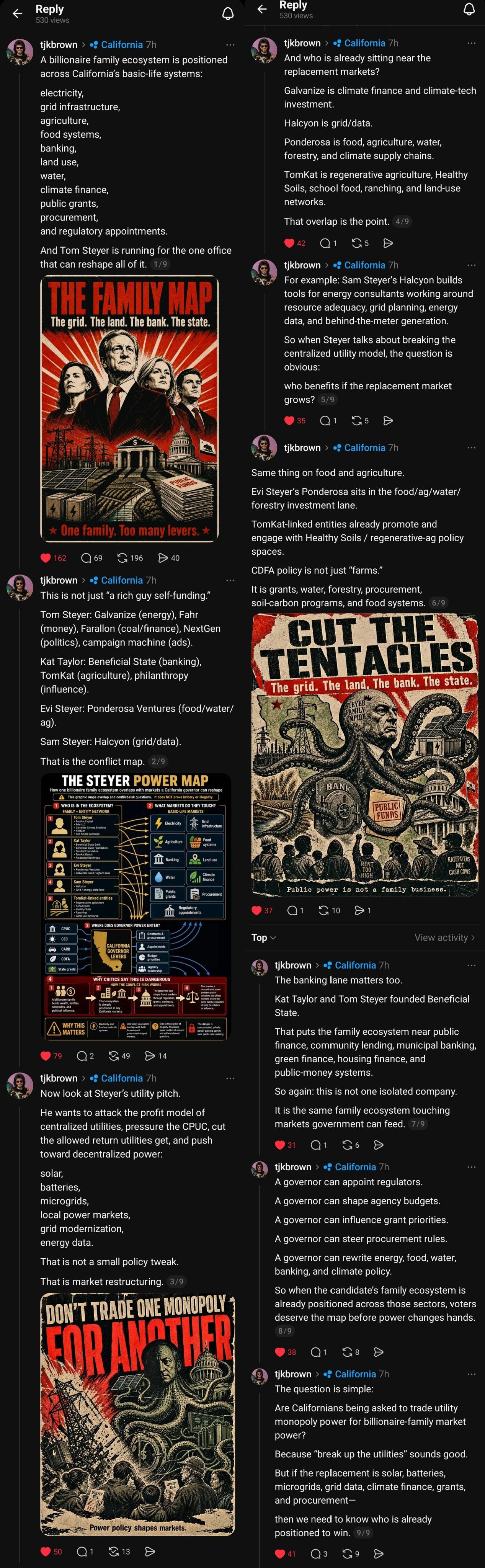
The thread above, compiled by @tjkbrown, is what shifted our read from “ambitious billionaire” to something that requires a more specific accounting.
Here is what the Steyer family ecosystem looks like when you map it against the sectors a California governor controls:
Tom Steyer runs Galvanize Climate Solutions, a climate-focused investment firm that closed a fund of more than $1 billion in 2023 and has raised $370 million from institutional investors including pension funds, foundations, sovereign wealth funds, and banks. Galvanize’s entire return thesis depends on grid restructuring, utility decarbonization, and interconnection market reform in California. A governor appoints the CPUC regulators who oversee exactly those systems.
His wife, Kat Taylor, co-founded Beneficial State Bank, which operates in community banking, green lending, public finance, and housing systems. A governor shapes the grant priorities and public banking policy those institutions depend on.
His daughter, Evi Steyer, runs Ponderosa Ventures, positioned in food, agriculture, water, and forestry investment. A governor controls procurement rules and CDFA policy across those sectors.
His brother Jim Steyer runs Common Sense Media, which works on tech policy and AI regulation. A governor influences both.
And Sam Steyer’s Halcyon sits in grid data and energy consulting, built specifically around the regulatory work that surrounds utility reform.
Every sector. Every lever. One family.
@tjkbrown’s framing is precise: this is not a rich guy self-funding. It is a family ecosystem that has pre-positioned itself across the full regulatory footprint of the California governor’s office, and is now seeking the office itself. The question he poses to voters is direct. Are Californians being asked to trade utility monopoly power for billionaire-family market power? Because “break up the utilities” sounds good... until you map who is already sitting near the replacement markets.
His Own Words, On Record
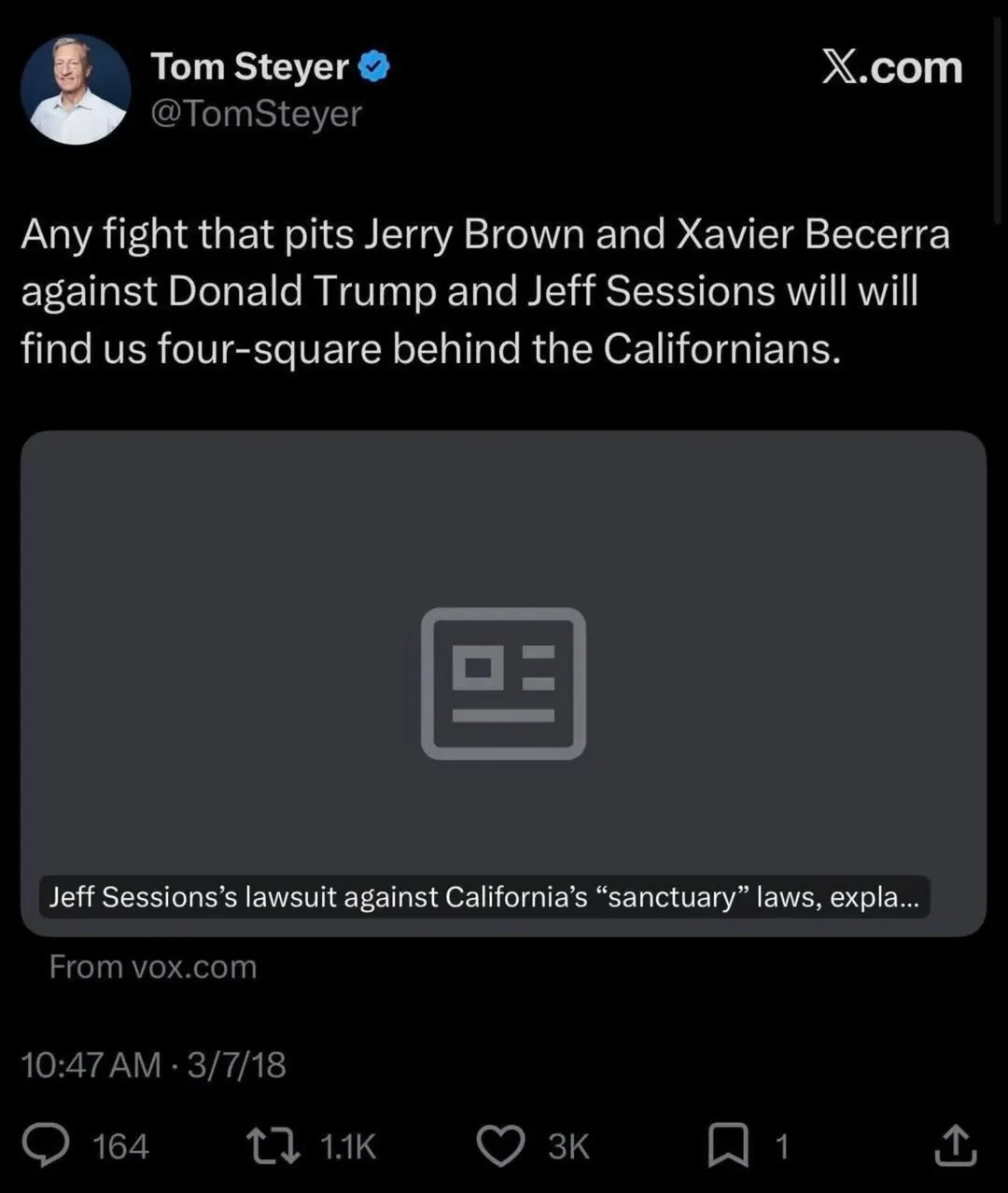
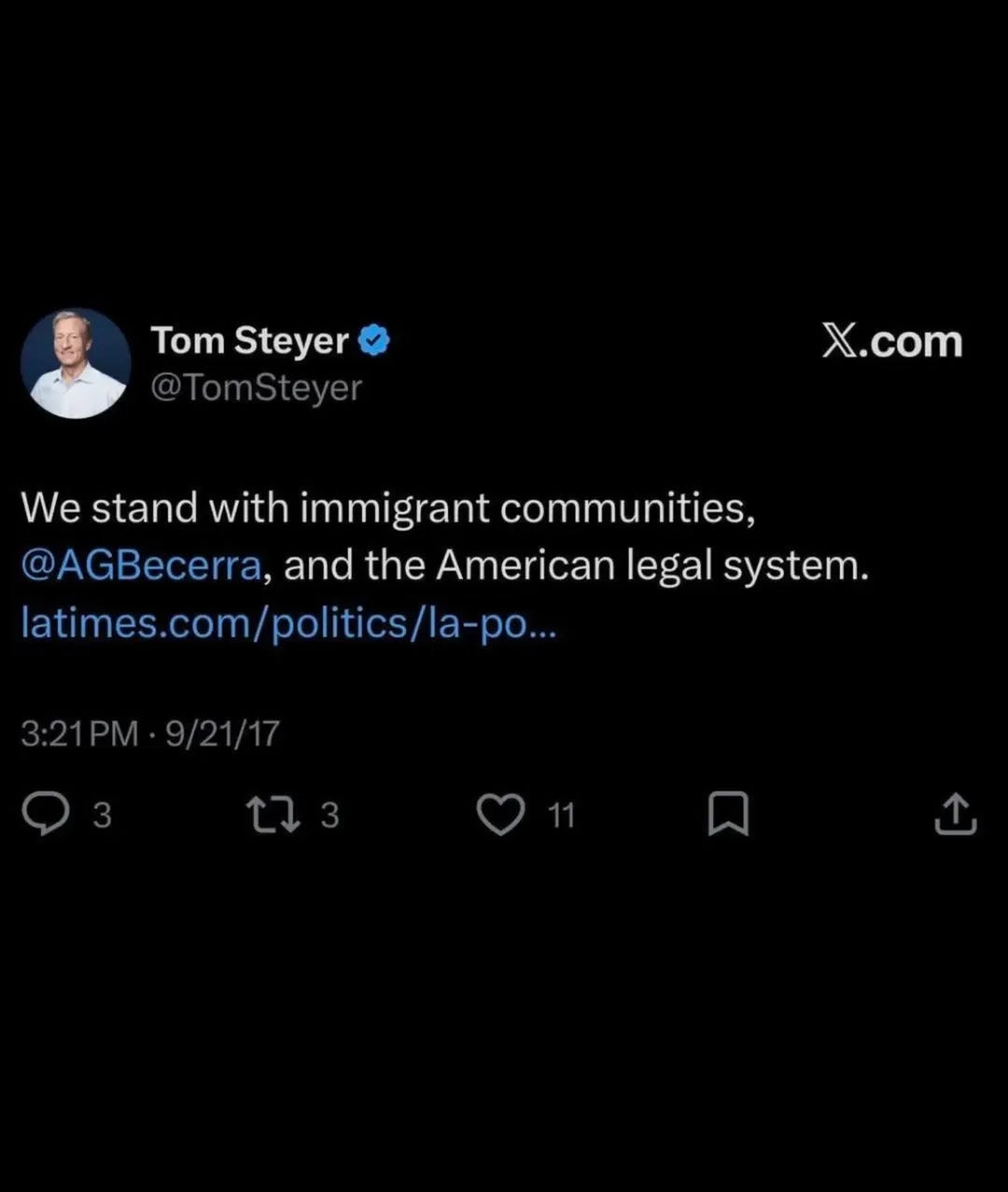
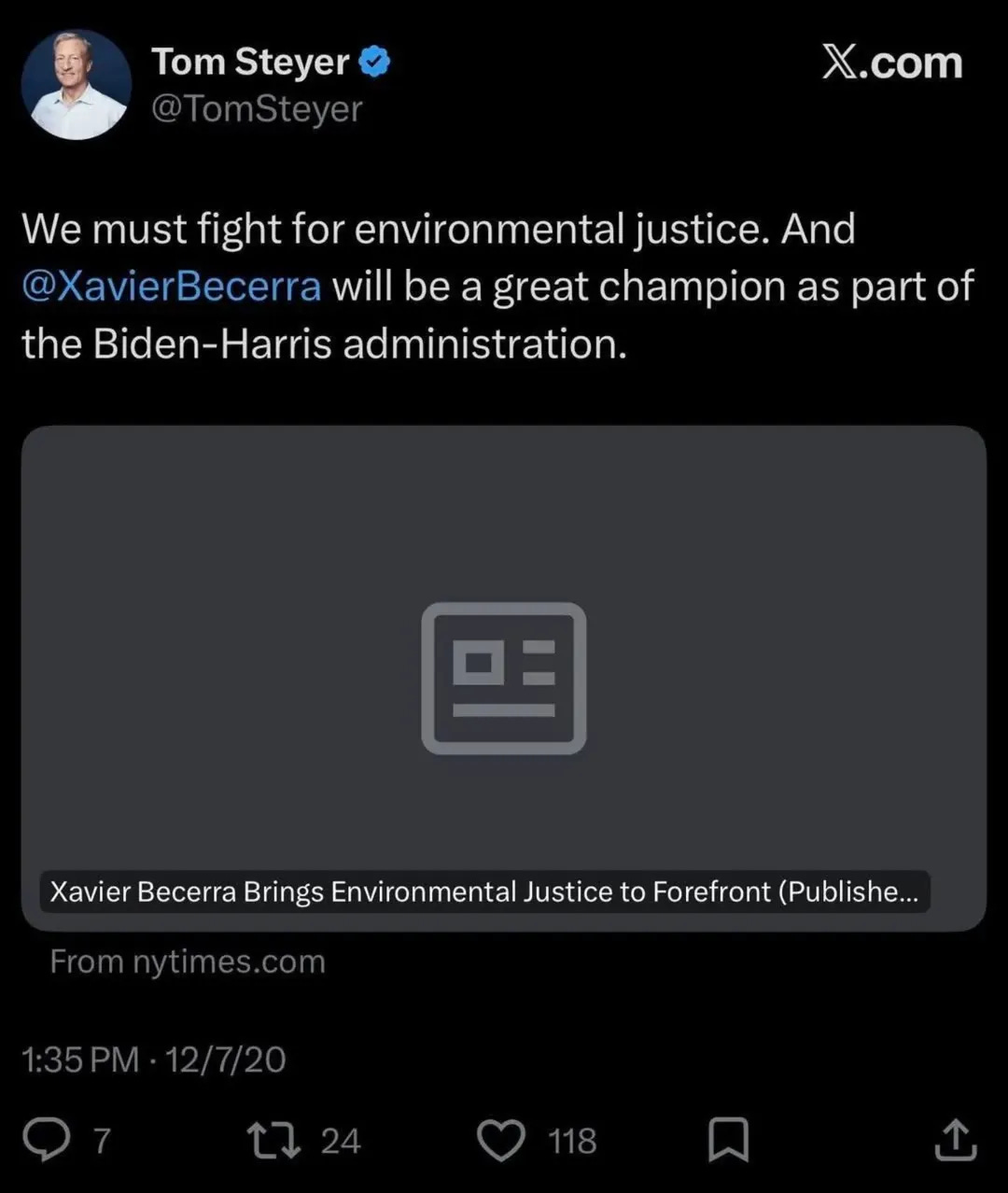
The three screenshots above are from Tom Steyer’s own verified Twitter/X account.
In September 2017, he publicly tweeted: “We stand with immigrant communities, @AGBecerra, and the American legal system.”
In March 2018, when Jeff Sessions sued California over its sanctuary laws, he tweeted: “Any fight that pits Jerry Brown and Xavier Becerra against Donald Trump and Jeff Sessions will find us four-square behind the Californians.”
In December 2020, when Xavier Becerra was nominated to lead the Department of Health and Human Services under Biden, Steyer tweeted: “We must fight for environmental justice. And @XavierBecerra will be a great champion as part of the Biden-Harris administration.”
That last tweet is worth sitting with. In December 2020, Tom Steyer publicly declared Xavier Becerra a future great champion of environmental justice. In 2026, the same Tom Steyer is running ads calling Becerra the chosen candidate of Chevron who cannot be trusted to protect California’s environment.
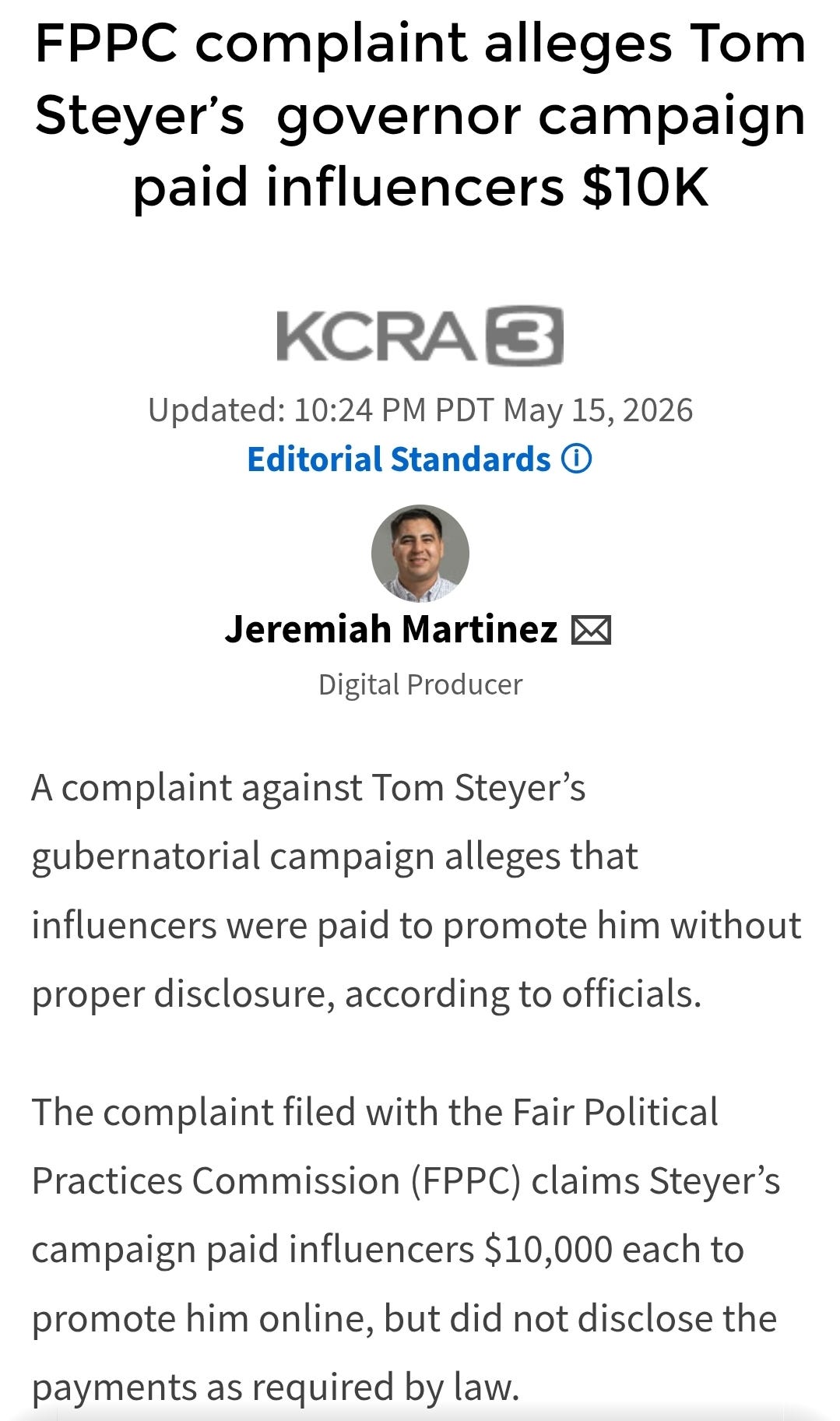
Nothing about Becerra’s environmental record changed between 2020 and 2026. What changed is that Becerra became Steyer’s primary competition for the governorship. The tweets don’t just show hypocrisy. They show that Steyer knew Becerra’s record was strong, said so publicly, and is now deliberately distorting that same record for electoral advantage.
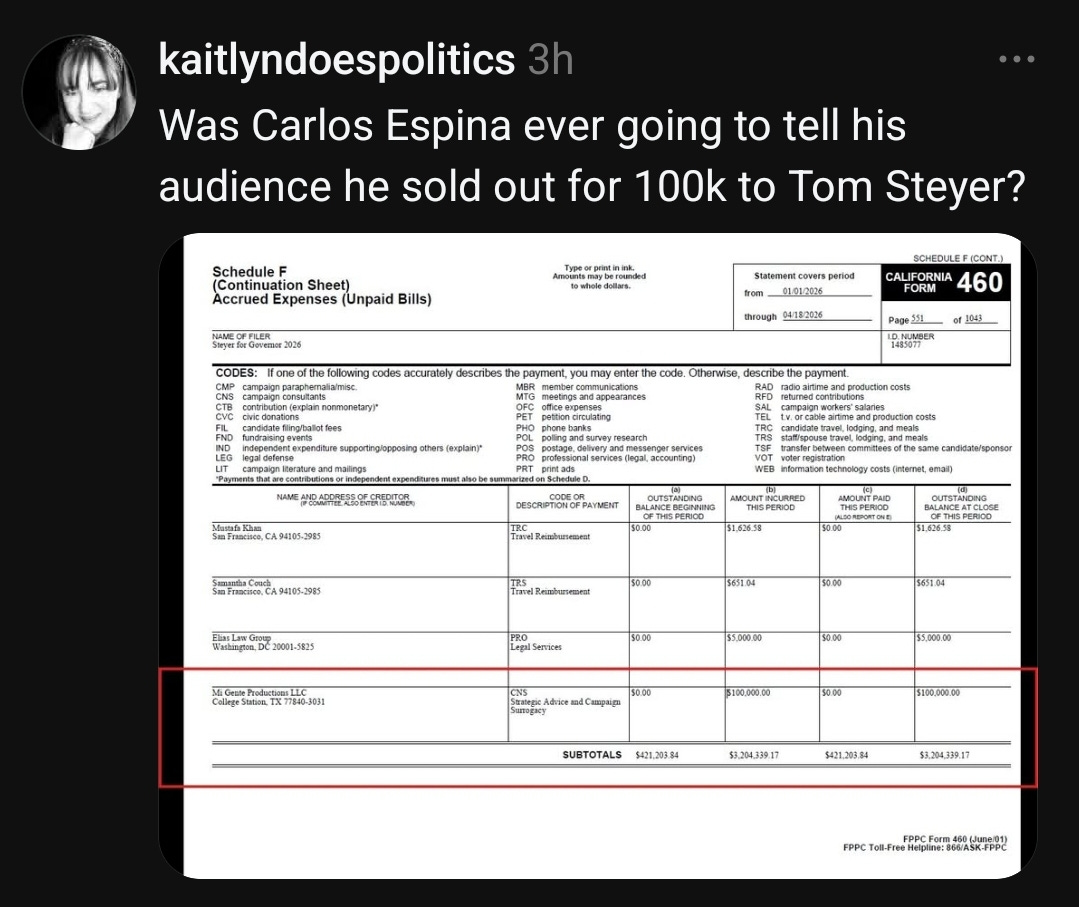
This is not, it turns out, the first time Tom Steyer has deployed the “I just found out, the team did it” script. In November 2019, during his presidential campaign, the Associated Press broke the story that his top Iowa adviser Pat Murphy, a former Iowa House Speaker, had been privately offering campaign contributions to local politicians in exchange for endorsements. When confronted about it on camera in South Carolina, Steyer said he had learned about the allegations while driving to the event. Murphy called it a “miscommunication.” Murphy resigned the following day after the campaign completed what it called an investigation, with the campaign manager issuing a statement that such conduct “is not tolerated.” Seven years later, when his team posted “Chevron es mi familia” in response to Becerra’s Spanish-language outreach, Steyer said he learned about it after the fact, the team took it down immediately, and if people were offended he was sorry. The words change. The structure of the response does not. And in both cases, the underlying attack the incident was built on... was simply reasserted in the same breath as the apology.
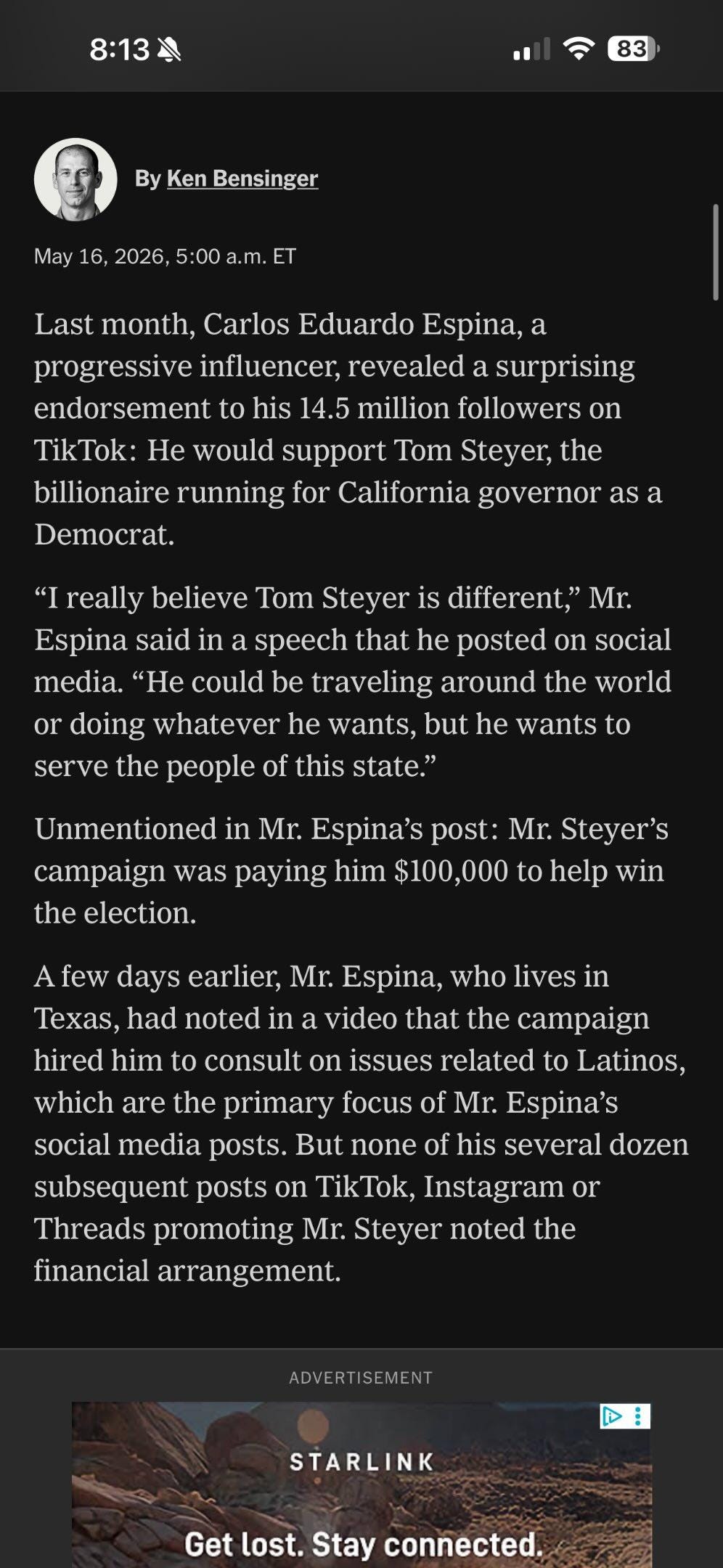
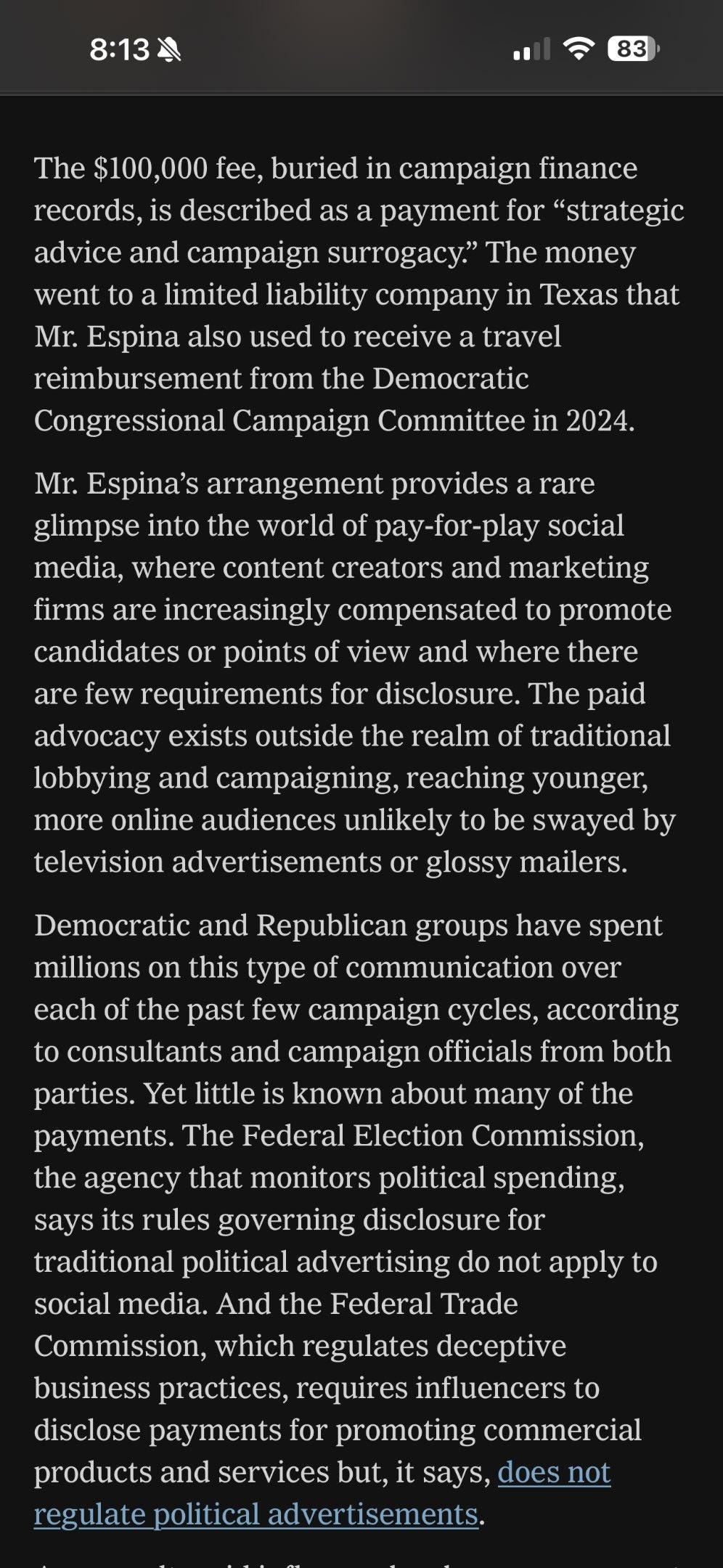
And then there is the single-payer healthcare issue, where Steyer and Katie Porter have both been hammering Becerra for refusing to give a simple yes or no answer on whether he supports it. Becerra’s position… that the implementation is more complicated than a bumper sticker allows… gets characterized as evasion. Except that Substack writer Ariella Elm (@ariellaelm) got close enough to Steyer directly to hear what he says when the cameras are not pointed at a rally crowd. Her account is worth reading in full: he told her he thinks it’s complicated too. He just won’t say so publicly. If you want to know what that looks like up close, including what she made of his post-debate warmth toward the Republican candidates before the cameras cut… the same pattern documented in this article… her piece is linked here: Who Am I Endorsing for California Governor? The through-line is consistent. What Tom Steyer tells voters and what Tom Steyer says when he thinks he is speaking candidly are not the same thing. The tweets above reflect the very same pattern. One which Tom would seem to not realize… we can all see.
Portrait of a Billionaire’s Hypocrisy-Laced Desperation: The $39,000 Attack and What the Community Said
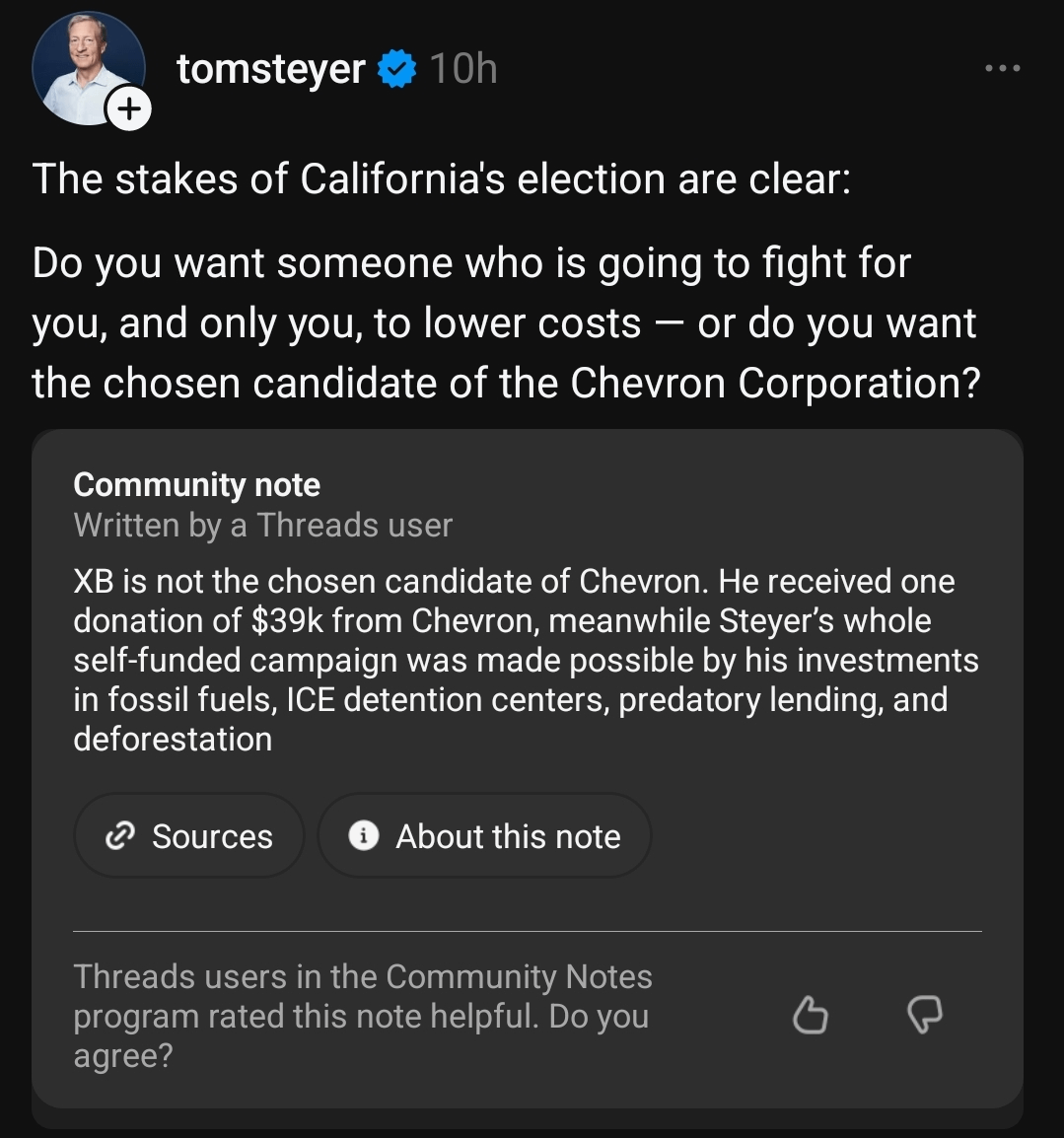
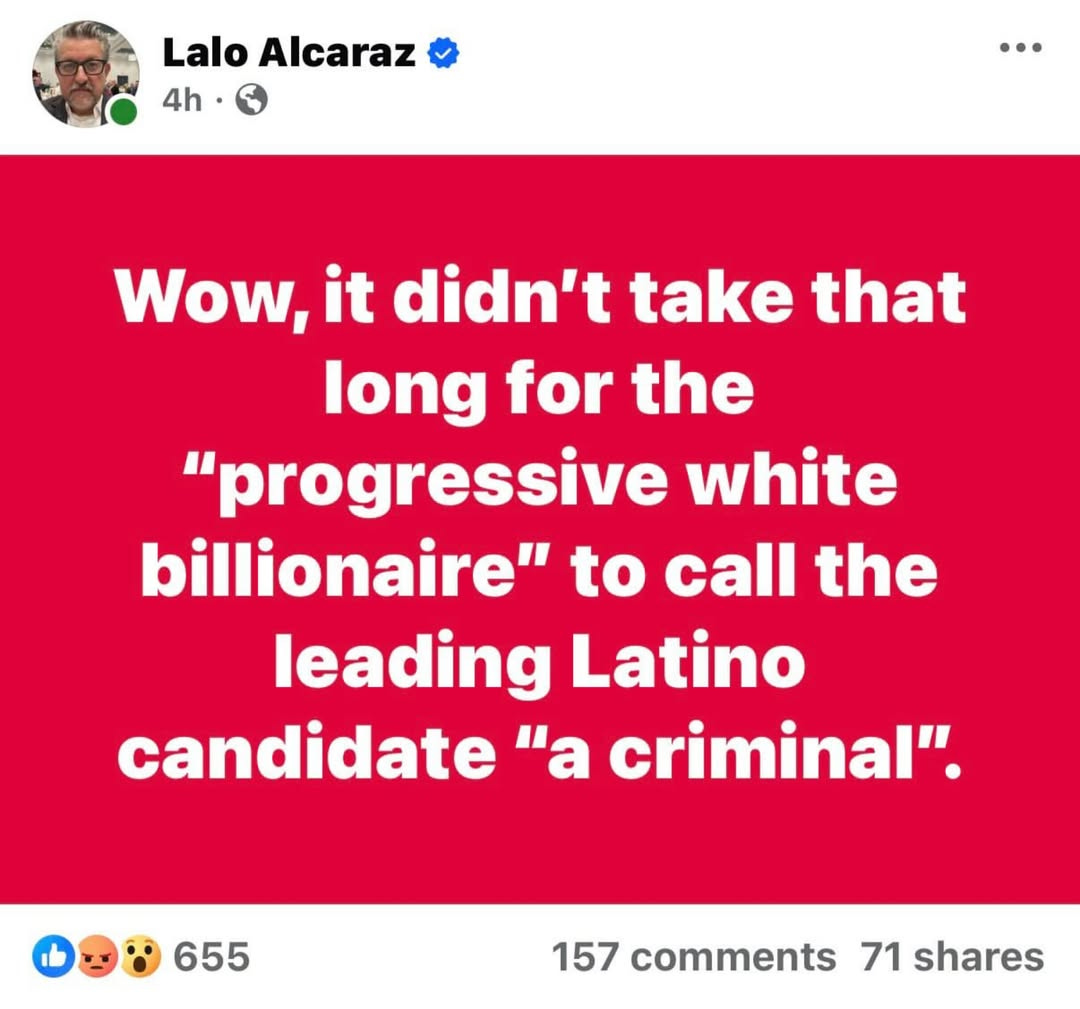
When Steyer posted on Threads asking voters whether they wanted “someone who will fight for you” or “the chosen candidate of the Chevron Corporation,” Threads users fact-checked him in real time.
The Community Note, rated helpful by the platform’s user base, reads: “XB is not the chosen candidate of Chevron. He received one donation of $39k from Chevron, meanwhile Steyer’s whole self-funded campaign was made possible by his investments in fossil fuels, ICE detention centers, predatory lending, and deforestation.”
That note is accurate. Every element of it is supported by public record, SEC filings, and tax documents.

Steyer also held a press conference accusing Becerra of being “bankrolled” by Chevron. That post received its own Community Note: “Chevron is not bankrolling Xavier Becerra. They donated less than 1% of his total campaign donations.”
The platform’s own users, independently and without coordination, are doing the factual work that Steyer’s $147 million operation is trying to prevent.
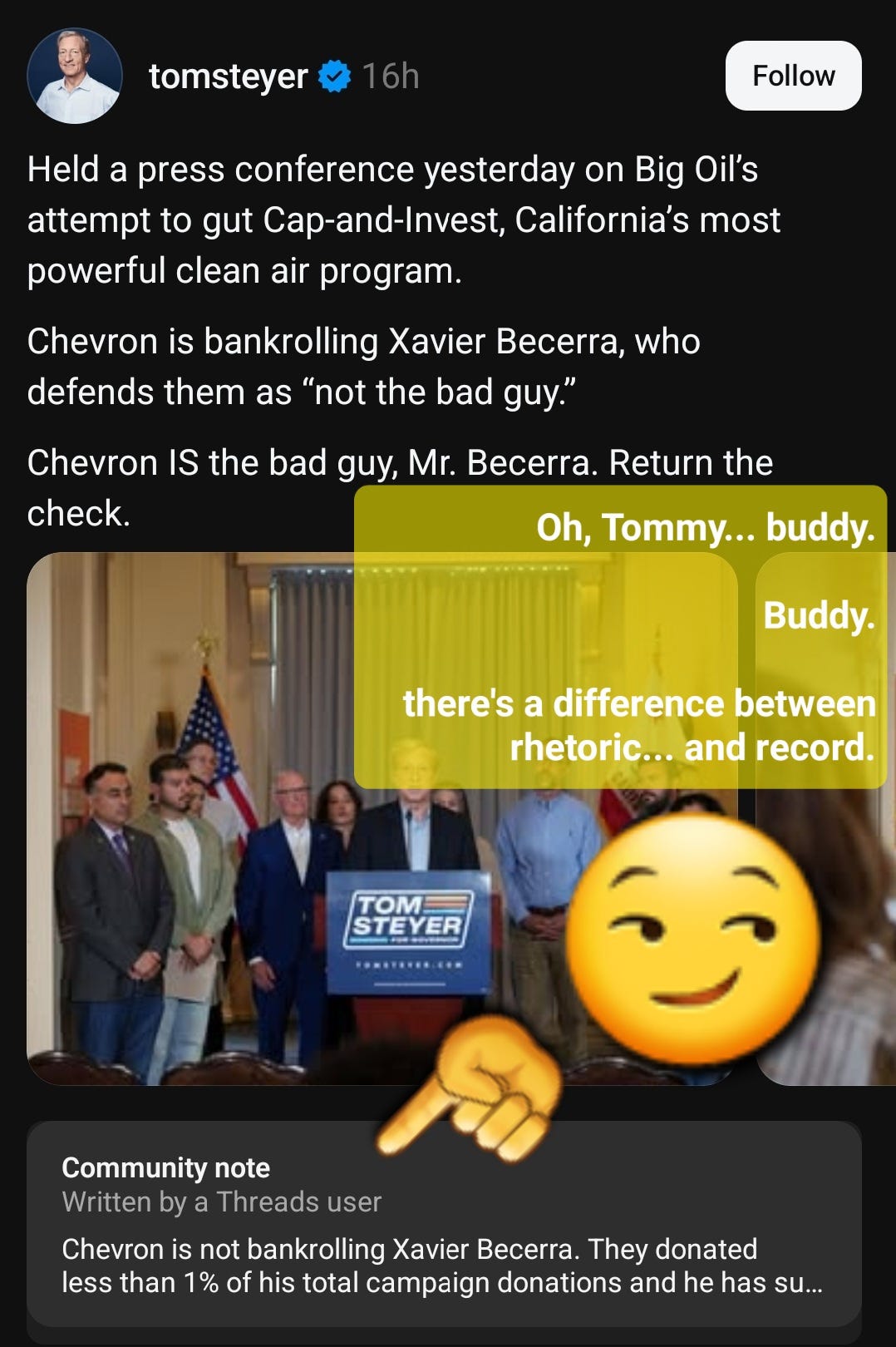
At that press conference, Steyer said this about Becerra accepting the $39,200 check: “If you take the money, you have an implied obligation to earn it.”
His words. Now apply that statement to $370 million in institutional capital whose returns flow directly through the California regulatory apparatus... and a family ecosystem positioned across every lever that apparatus operates.
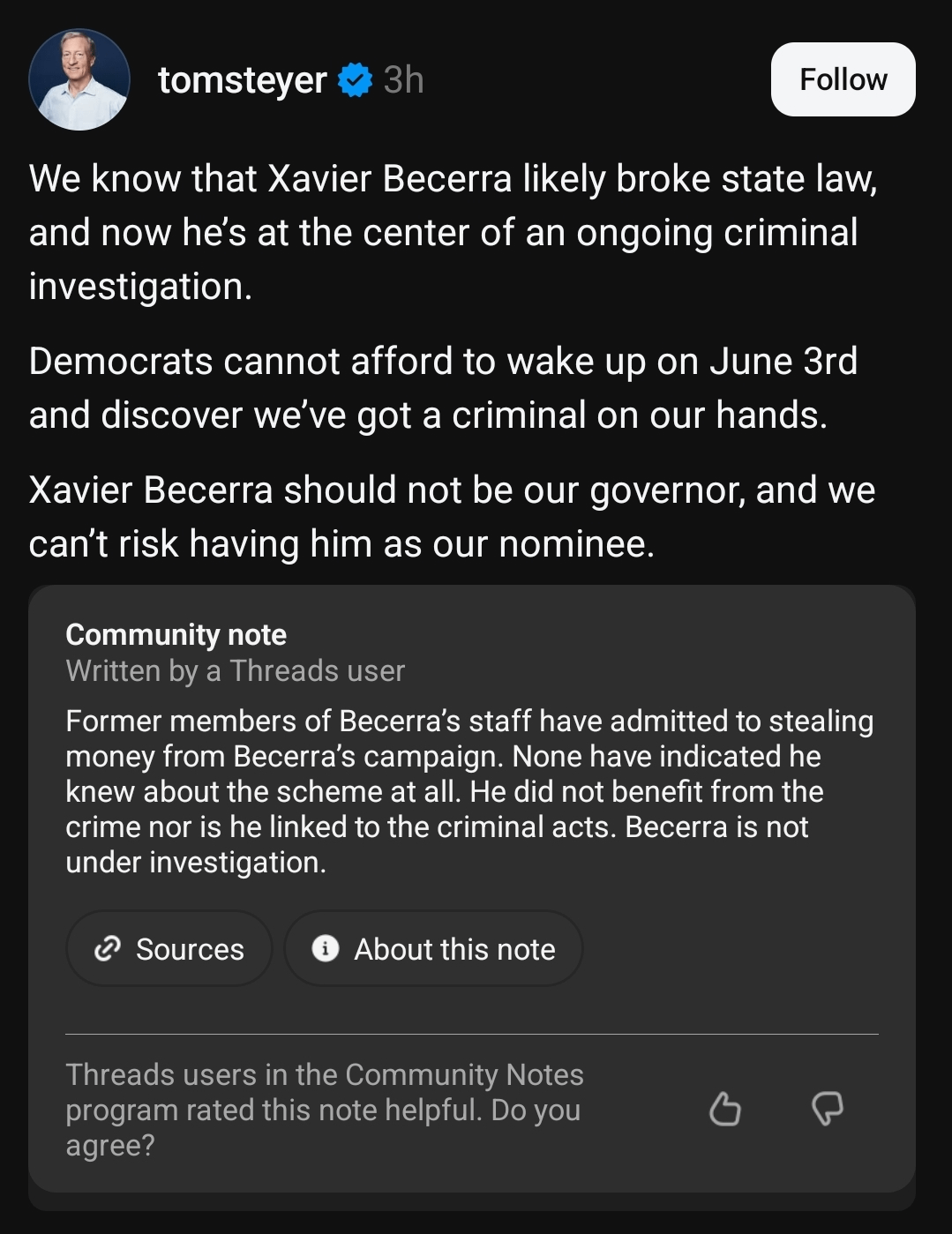
The implied obligation runs in a specific direction. It is not toward California’s voters.
No Warmth for Becerra, but the Oath Keeper Gets a Hug
At multiple debates in this race, a pattern emerged that nobody on Tom Steyer’s campaign staff thought to address. After the cameras cut and the stage cleared, Steyer sought out Chad Bianco. Not a professional handshake. A full embrace. Repeated. At each debate, and only with Bianco.
One Threads observer put it plainly: “I don’t know about the HQ post but I did notice this on Steyer’s hand and how he continues to hug on Chad Bianco, and only him, at each debate.”
This from the man who calls himself the most progressive candidate in California’s governor race. The man who says ICE is “a criminal operation.” The man whose entire campaign positioning is built around his distance from MAGA.
It is useful to know who Chad Bianco is.
His name appeared in the leaked Oath Keepers membership rolls in 2021. At the CNN debate on May 5, 2026, when Antonio Villaraigosa confronted him about it on a nationally televised stage, Bianco did not retreat. “I’m very proud of it,” he said. Becerra called the answer “chilling.” Villaraigosa said flatly that an Oath Keeper is not qualified to be California’s governor.
The record beneath that pride: Bianco’s department ranks dead last among all 57 California sheriffs in crime-solving, clearing 9.2% of reported offenses... less than half the state average. Riverside County’s jails account for 17% of California’s jail homicides while housing only 6% of its incarcerated population. The California Department of Justice opened an investigation into his department for unconstitutional policing, excessive force, and inhumane conditions. In 2026, he ordered the seizure of over 650,000 ballots based on claims from a citizens’ activist group, a move subsequently ordered unsealed by both a county judge and the California Supreme Court.
Source: Center on Juvenile and Criminal Justice; Wikipedia; Raw Story; CalMatters
No warmth was extended to Xavier Becerra after those same debates. The man calling himself California’s progressive standard-bearer reserved his full embrace for the candidate proud of his Oath Keeper ties.

We’re not suggesting a conspiracy. We’re noting a pattern of warmth and a pattern of cold, and leaving the geometry visible without naming the shape.
A Video About Theodore Roosevelt, Surfaced at an Interesting Time
Someone recently surfaced a video about Theodore Roosevelt. No explanation offered. No connection drawn. Just... there it is, dropped into the timeline at a moment when California Democratic voters who wanted Xavier Becerra may find themselves being asked to choose between the party apparatus and a billionaire who has decided this is his moment.
We’re not saying anyone made a comparison. We’re noting the timing of what was surfaced, and once more simply leaving the geometry visible without naming the shape. So let's begin to follow its lines and angles here as well. The video describes a wealthy man who positioned himself as a champion of the people, whose relationship with that positioning was complicated by his own class interests. It arrived in the public conversation precisely when voters are being asked to assess another wealthy man making similar claims. The reader can draw whatever line they draw.
Since the video is now in the conversation... let’s note what the historical record actually shows.
Theodore Roosevelt grew up in a family whose political influence had been displaced by the new men of great wealth... men who lacked any tradition of public service and who had seized the levers of government to serve their own business interests. TR’s entire project was a reassertion of the principle that the state governs capital, not the other way around. He pursued antitrust litigation against 44 major corporations. He broke up Standard Oil. He busted J.P. Morgan’s railroad trust. He used the regulatory apparatus of government to constrain consolidated private power.
Tom Steyer is running for the office that operates the regulatory apparatus his own capital depends on, with a family ecosystem already embedded across every sector that apparatus governs. Roosevelt busted trusts. Steyer has assembled one, across energy, agriculture, water, banking, and tech policy, and is now running for the office that runs its regulatory levers.
There is one more disanalogy that matters. In 1912, Roosevelt ran as the Bull Moose candidate knowing he would very likely lose and hand the presidency to Woodrow Wilson. He ran anyway, because he believed his chosen successor had betrayed what the Square Deal stood for. That is not the behavior of a man protecting a financial thesis. It is the behavior of a man willing to lose for something larger than himself.
Steyer has spent $147 million of his own money on this race. He is running defamatory ads. He is making statements his own tax returns contradict. He is attacking a man whose environmental record he publicly praised three years ago.
He is not willing to lose gracefully. TR accepted loss as a condition of the game. These are not the same man.
Or put another way... the historical record reveals Theodore Roosevelt. The historical record knows Theodore Roosevelt. And Tom Steyer... you are no Theodore Roosevelt.
The Symbol on His Hand
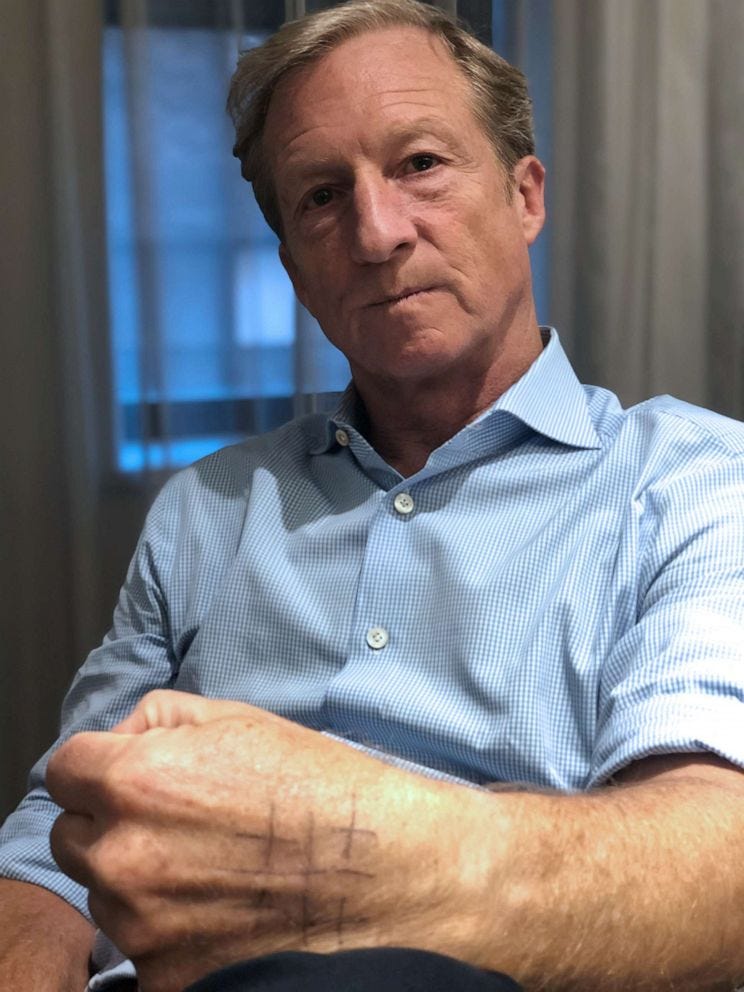
The marking on Steyer’s left hand has been visible since at least 2019, when he was running for president. It is a Jerusalem Cross, a symbol originating in the 13th-century Crusader Kingdom of Jerusalem, established when European Christian forces conquered Muslim lands.
Steyer has said for years that he draws it daily to remind himself to tell the truth.
Both the Southern Poverty Law Center and the Anti-Defamation League have documented that far-right groups have co-opted Crusader symbols to signal anti-Muslim sentiment and what the SPLC describes as “this notion that Christianity needs to retake western civilization.” Multiple staff members reportedly raised this with Steyer directly and urged him to stop. He refused, saying it meant something else to him personally and he was going to keep wearing it.
The swastika originated in Asian spiritual traditions and carried positive meaning for thousands of years before it was co-opted. That history does not neutralize what the symbol communicates in the current cultural context where it is being displayed. The same logic applies here.
A man seeking the governorship of the most ethnically and religiously diverse state in the country, who has been specifically told that a symbol he is publicly displaying has been adopted as anti-Muslim signaling by extremist groups, and who chooses to continue displaying it anyway... that tells you something about how he weights the concerns of the people he says he wants to govern.
He was told. He persisted. That is the data point.
What Becerra Actually Did With the Oil Money He Took
Content creator Jose Torres (@Josecanyouseeby on Instagram) laid this out clearly, and the sourcing holds up.
As California’s Attorney General, Xavier Becerra accepted a $39,200 donation from Chevron. He then led multistate coalitions suing Chevron, BP, Shell, ExxonMobil, and ConocoPhillips in federal appeals courts on behalf of Oakland, San Francisco, Baltimore, New York City, and Rhode Island, seeking to hold those companies accountable for the costs of climate damage and sea-level rise. He sued the EPA twice for failing to reduce methane emissions from oil and gas operations. He sued Valero Energy to stop the company from acquiring the last independent petroleum distribution terminal in Northern California. He won. He co-led a coalition challenging the gutting of methane waste prevention rules covering hundreds of oil and gas leases across more than 200,000 acres of federal land in California.
He also sued two multinational gasoline companies for manipulating California’s gas market, exploiting the 2015 Torrance Refinery explosion to artificially spike prices against California consumers.
This is the environmental record of the man Tom Steyer is calling Chevron’s chosen candidate. The legal filings are public. The defendants include Chevron. The lead attorney general is Xavier Becerra.
Jose also correctly noted that this is not the first time Steyer has run this exact playbook. At a 2020 presidential debate, Joe Biden called him out directly for his coal investments while Steyer was positioning himself as the only genuine climate candidate in the field. The New York Times subsequently fact-checked Steyer’s claim that he had divested from fossil fuels, finding that his financial disclosures still showed investments tied to oil and gas. He is running the same script six years later against a different target, hoping the voters in this race have not seen the rebuttal.
In 2026, Becerra’s record on fossil fuel accountability is not a liability. It is one of the strongest parts of his case. Steyer knew this. He said so publicly in 2020. He is counting on you not to.
A Note on Gavin Newsom
We will be brief here because we have said elsewhere what we think of Gavin Newsom at length, and readers who want that full accounting can find it below.
TikTok’s FriendlyHoneyBadger has stumbled upon something manipulative brewing in social media between MAGA & Gavin Newsom... against the left.
The relevant observation for this article is narrower. Gavin Newsom has not endorsed in this race, partly because he is term-limited and partly because he is positioning for a 2028 presidential run, which means he has an interest in not alienating whichever Democrat wins California’s governorship. Xavier Becerra is not running as a Newsom corrective. He is not campaigning on the failures of the Newsom years. He is running as the experienced, values-consistent institutional choice, which means he carries some of the same establishment alignment that makes Newsom frustrating to many California progressives.
We note that, and we are not pretending it is not a real consideration. For voters who look at California’s housing costs, utility rates, homelessness numbers, and income inequality under four years of Newsom and want something genuinely different, Becerra does not fully answer that call. He answers a different one.
Whether that is disqualifying is a judgment each voter makes for themselves. Our view is on record, and it comes later in this piece.
The ‘85,000 Lost Children’ Attack: What an Immigration Attorney Who Actually Worked With Those Kids Wants You to Know
One of Steyer’s persistent attacks against Becerra has been a claim that as HHS Secretary he “lost” 85,000 unaccompanied migrant children. It is a devastating-sounding charge. Immigration attorney Kathleen Martinez (@attorneymartinez on Instagram), who worked directly with these children, explains what the claim actually describes... and what Steyer either does not understand or is choosing to misrepresent.
Here is how the system actually works. When an unaccompanied minor arrives at the southern border, they are placed in the care of HHS’s Office of Refugee Resettlement. ORR finds a sponsor for the child... typically a parent, family member, or family friend already in the United States. Once the child is placed with that sponsor, HHS’s legal custody and responsibility ends. The department makes three follow-up calls to the sponsoring family. If those calls are not answered, HHS has no legal authority to compel entry into the home. Becerra’s jurisdiction stops there. By law.
What happens next falls entirely to a different agency. Once placed with a sponsor, the child is immediately put into removal proceedings and responsibility transfers to the Department of Homeland Security, specifically ICE, which is required to issue a Notice to Appear in immigration court. It is ICE’s job to send that notice to the correct address. It is ICE’s job to maintain the paperwork. It is ICE’s job to track whether the child appeared in court. Becerra’s department is not in that chain. Tom Steyer is either unaware of this or is counting on voters to be.
The federal record on ICE’s performance of that job is not ambiguous. The Department of Homeland Security’s own Inspector General released a management alert in August 2024 finding that ICE “was not able to account” for unaccompanied minors who failed to appear for immigration court proceedings or were never served a Notice to Appear at all. According to the OIG report, 291,000 unaccompanied minors had not been issued Notices to Appear as of May 2024. Another 32,000 received a notice but did not appear in court. ICE, the report found, did not have an accurate, effective, or automated process for sharing information. Officials were tracking children using spreadsheets and email. 31,000 children released to a sponsor did not have a correct address on file with immigration officials.
Source: DHS Office of Inspector General, Management Alert, August 2024; National Immigration Forum; Nextgov/FCW; Government Executive
Kathleen Martinez points to something practitioners know that the political attack omits entirely: half these children did not know the address of the sponsor they were going to live with when they arrived at the border. The other half of the time, the address ICE recorded was wrong to begin with. Children who came to her office had missed court dates because ICE had sent their notice to the wrong address, or had never sent one at all. She spent hours on individual cases calling ICE to reconstruct what happened to their files.
The “missing children” framing itself originated in a New York Post article citing the OIG report. The Trump campaign amplified it, asserting without evidence that the vast majority of these children were being exploited or trafficked. Republican elected officials repeated it across the country. Tom Steyer imported the same framing into a Democratic primary in California to attack a man whose department’s legal jurisdiction over these children ended the moment they were placed with a sponsor.
As Attorney Martinez put it: this was not a missing children problem. It was a missing paperwork problem. The paperwork belonged to ICE. The attack belongs to Steyer. Neither belongs to Xavier Becerra.
Now consider what this attack actually required someone to believe. That Xavier Becerra… the son of a Mexican immigrant mother and a father who grew up in Tijuana, who wore his father’s ring in Congress because a lifetime of physical labor had made it too small to fit, who began his legal career representing the most marginalized people he could find, who as Attorney General led the legal fights to protect immigrant communities from Jeff Sessions, Donald Trump, and ICE itself… that this man lost immigrant children because he didn’t care about them. The Coalition for Humane Immigrant Rights of Los Angeles called it for what it is, condemning the attacks as based on Trump’s lies and the exploitation of vulnerable people as political ammunition. The executive director of the Central American Resource Center of Los Angeles said it plainly: it is shameful that a billionaire who became rich at the expense of family separations would criticize someone with Becerra’s record.
Source: CHIRLA Action Fund statement; CARECEN-LA, calonews.com, April 2026
And then there was the post.
Becerra had written, in Spanish: “En mi familia, everyone has a seat at the table.” It was a straightforward campaign message, in a language that reflects who he is and who he is speaking to. Steyer’s official campaign account … @TomHQ … responded: “Chevron es mi familia.” A white billionaire’s campaign operation reached into the Spanish word a Latino candidate used to describe his own identity and his vision for California, and turned it into a punchline. Then deleted it.
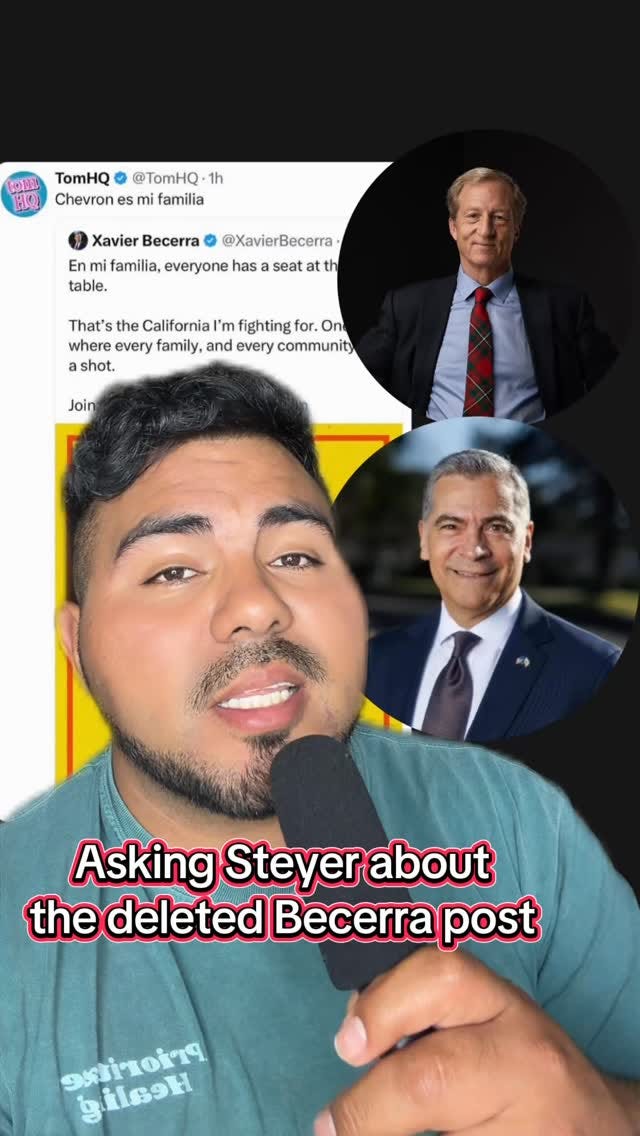
When asked about it on camera, Steyer said he didn’t know the post had gone out. His team put it out. When they heard about it, they took it down. There was absolutely no attempt to be rude or insulting. And: “if people were offended, I’m really sorry.”
If people were offended.
Not: we were wrong. Not: I understand why that caused harm. If. The conditional apology that locates the problem in the sensitivity of the people harmed rather than in the act itself. And then, in the same breath, without pause, he pivoted to doubling down on the precise Chevron claim the post was built on. The one that has now been Community-Noted as false on Threads. The one his own archived tweets contradict. He faux-apologized for the words and re-prosecuted the lie in under thirty seconds.
The structure of that response is its own portrait. Deny personal knowledge. Attribute it to the team. Offer a conditional apology. Immediately reassert the underlying attack which he was already exposed for building from his own willingly distorted deception. To help trick the public into giving him and his family power over the fourth largest economy in the world. This… is not the behavior of a man who thinks something wrong was done. It is the behavior of a man who thinks the wrong thing got caught.
One wonders what it takes to not see the full geometry of this. A campaign operation co-opting Spanish to mock a Latino candidate’s use of “familia” while its candidate profits from the private prison infrastructure that detained that candidate’s people. A billionaire who bought stock in ICE detention facilities performing outrage about immigrant children on behalf of immigrant communities. A man who drew a symbol on his hand associated with anti-Muslim sentiment, who warmly embraced a proud Oath Keeper after every debate, who now stands in front of cameras and says the words “if people were offended” about co-opting the language of a community he has never been asked to survive.
There is a pattern here. It is not subtle. And the communities it keeps brushing against are not required to extend the benefit of the doubt to a man who keeps requiring it.
Xavier Becerra: The Full Account, Including the Parts That Are Complicated
His father’s wedding ring no longer fit after a lifetime of physical labor. Becerra wore it in Congress anyway.
That detail is not offered as sentimentality. It is a data point about formation. His mother immigrated from Mexico. His father grew up in Tijuana. He was the first in his family to graduate from college, earning a degree in economics from Stanford, then a law degree from the same institution. His first job out of law school was in legal aid, representing people with mental illness in Boston. His career in elected office began in the California State Assembly and then ran through twelve terms in the U.S. House of Representatives, where he became the first Latino to serve on the Ways and Means Committee.
When Jerry Brown appointed him California Attorney General in 2017, the first thing he did was file lawsuits. He filed 122 of them against the Trump administration. He won the majority. He created an environmental justice bureau within the California Department of Justice. He led the multistate litigation coalitions against the fossil fuel industry documented above. He won a $575 million antitrust settlement against one of California’s largest health systems. As HHS Secretary under Biden, he secured the first-ever federal drug price negotiations in American history, achieving discounts of 38% to 79% on ten high-cost medications including Eliquis, Jardiance, and Xarelto, saving Medicare an estimated $6 billion in 2023 alone. He then announced fifteen more drugs for negotiation, including Ozempic, Ibrance, and Vraylar.
As is the currency of election campaigns, many running rely on rhetoric in lieu of a record yet to be proven. Steyer is rhetoric powering an escape from his own damning record. Becerra is pure record of institutional work producing concrete outcomes.
The honest accounting also includes the complications.
His management of HHS during the pandemic drew real criticism for low public visibility at moments that required it. When the Biden White House was trying to communicate clearly about COVID policy, Becerra was not the face of that effort in the way the moment called for. His response to the 2022 monkeypox outbreak was slow. White House officials, not Republican critics, said he sought to deflect responsibility onto the states rather than own the federal response.
His single-payer positioning in this race has been inconsistent in a way that looks like it was calibrated around the California Medical Association endorsement. He has denied this. The denial has not been especially convincing. (Yet, once again, we remind you of Ariella's piece on Tom Steyer’s reveal to her that he's been obscuring from the public his essentially having the very same perspective on single-payer medical care as Becerra. Yet another distortion that is effectively designed to coax voters into making a misinformed vote in Steyer’s benefit.)
Becerra is not always an electrifying speaker. His rise in polls was triggered largely by Eric Swalwell’s implosion rather than an organic groundswell of enthusiasm. These are real limitations in a race where visibility and energy matter.
None of them change the underlying calculus. There is no documented evidence that Xavier Becerra has ever subordinated the interests of California’s people to his own financial interests, because he does not have financial interests of that kind. His net worth, accumulated through decades of public service salaries, is not in the same universe as the structural conflicts embedded in Steyer’s investment ecosystem. His record of taking on the industries that donated to him, rather than accommodating them, is specific and verifiable. His biography makes his stated values legible in a way that Steyer’s pivot from “Mr. Oil’s” son to climate champion never quite manages.
His father’s ring barely fits anymore. That is the formation.
Why the BSofA Backs Becerra
We want to be clear about where we stand and why, because readers deserve to know the lens through which this publication approaches this race.
We are not fans of Gavin Newsom. That is on record and the link above says the rest. We did not back Becerra because he represents a clean break from everything about California’s recent political leadership that frustrates us. He doesn’t, entirely.
We back Becerra because of what the full record, examined honestly, actually shows.
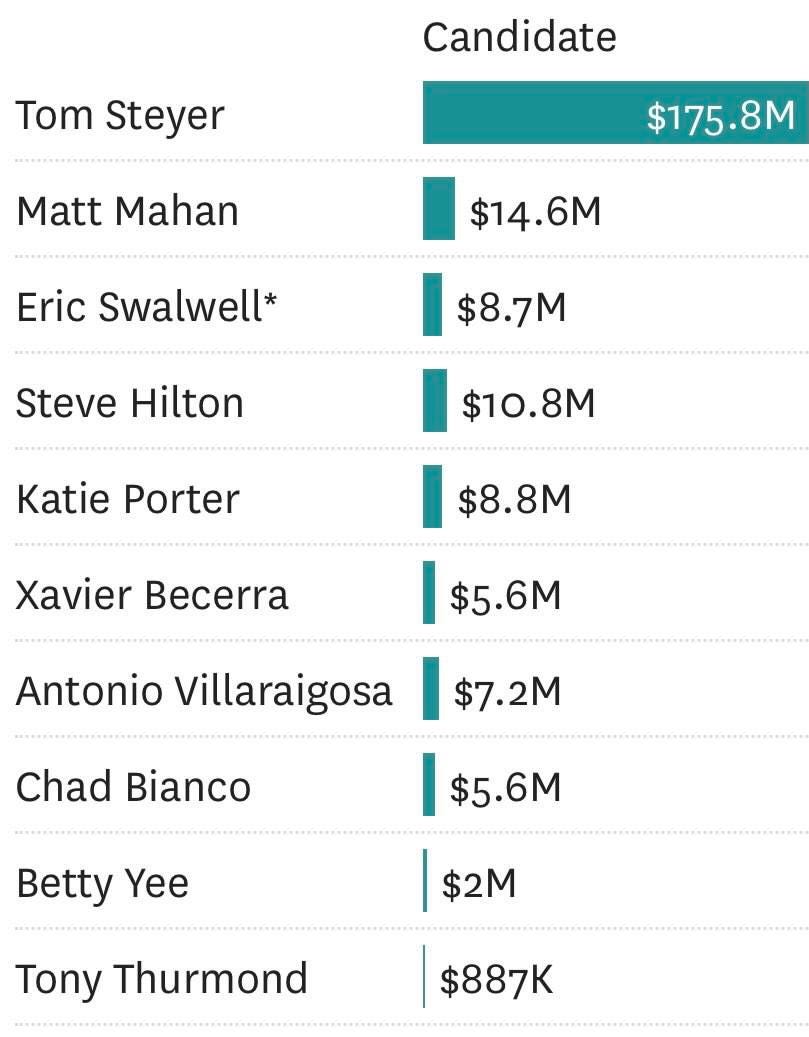
Tom Steyer is running for an office whose regulatory levers his own investment ecosystem depends on. He has spent over $175 million of his own money doing so. He has been fact-checked by his own platform’s community notes on his core attack line. He has made statements that his tax returns contradict. He praised Becerra’s environmental record publicly in 2020 and is now deliberately distorting it. His staff warned him about a symbol co-opted by white nationalists, and he kept drawing it on his hand. He was called out for coal investments by Joe Biden in 2020 and repeated the same “only clean candidate” performance in 2026 against a different opponent.
The fear we observed early in this race has a source now. A man whose investment firm’s thesis, whose family’s institutional positioning, and whose implied obligations to $370 million in institutional capital all depend on specific regulatory outcomes the California governor controls... has every reason to exhibit that specific kind of panic. It's easy to chalk it up to mere vanity. Yet that ever present and expanding geometry comprehensively outlines that it is Steyer's structural exposure that keeps painting the expression of alarm on his face at every turn of Becerra coming closer to serving California's population exactly what they feel they want and need… from exactly the type of person that Becerra… duplicity-free… just authentically… is.

Becerra, based on 35 years of verifiable conduct, will use institutional power in service of the people he says he is serving, hold corporations accountable when accountability is warranted, and bring no private financial interest to the governor’s office that competes with the public interest for his attention.
No self-serving double agenda. No pursuit of power through distortion metrics and billion-dollar-funded narrative manipulation. Just… governance. To serve the people in the state of California. From the man who hasn't been building an empire on the devastation and exploitation of our environment and its people… before reaching for one ultimate power grab. But one who has instead shown the over three decade-long undeniable record of trying his best to do the right thing through the opportunities he worked hard to achieve so that he may continue further doing the right thing to an ever-growing and wider-spreading impact. And with successful record that includes bringing the Trump administration to justice over 120 times… he not only tries his best. He wins. In 2026 California, with what is at stake federally and what hangs on this race… that… is the choice.
Sourcing Note
The BSofA is an anonymous, ambiguously collective political commentary publication. We do not accept corporate advertising. We are not affiliated with any campaign. Sourcing for this piece draws on SEC filings; tax records reported by the Associated Press and Washington Times; investigative reporting from the New York Times and Reuters; California Department of Justice official press releases; FEC and CalAccess campaign finance records; Threads Community Notes; on-record statements from the candidates themselves; the Center on Juvenile and Criminal Justice fact sheet on Sheriff Bianco; Wikipedia; Raw Story; CalMatters; and research by independent content creators Kaitlyn Hennessy, Kathleen Martinez, and Jose Torres, whose videos are embedded throughout. The research thread by @tjkbrown on Threads is cited directly and linked throughout.
★★★
© Blindsided States of America™ 2026. All rights reserved.
Good breakdown. I didnt know his daddy worked for Sullivan & Cromwell who have ties to the Nazis, the CIA and a bunch of Nasty business.
Also, the housing stuff sounds innocuous, but Steyer has helped gentrify West Oakland and made a bunch of money off the mortgage crisis. https://www.sfchronicle.com/eastbay/article/sullivan-landlord-oakland-17769232.php
"Sullivan raised millions of dollars from investors, including former presidential candidate Tom Steyer, and he began buying dozens of properties in the area, then hundreds, through three primary LLCs — REO Homes 1, 2 and 3. Sullivan bought his homes in cash from banks and other lenders at foreclosure auctions for an average of $154,000 — less than half of what their previous owners had paid for them, according to the East Bay Express."
Thank you so much for writing this, this is super in depth and informative and helpful!